The Byzantine Art of War by Michael J. Decker
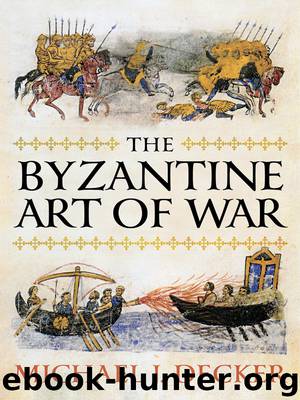
Author:Michael J. Decker
Language: eng
Format: epub
ISBN: 9781594165603
Publisher: Westholme Publishing
Published: 2017-07-04T16:00:00+00:00
SIX
ENEMIES OF BYZANTIUM
OVER THE MILLENNIUM OF ITS EXISTENCE, the Byzantines faced a vast array of peoples who threatened its territory and people. Several of these proved militarily superior and dealt heavy defeats on the empire. In the end, however, the Byzantines generally gained the upper hand, often through decades or even centuries of defense, stabilization, assimilation, and counterattack. The Byzantines learned a great deal from their enemies; indeed the ability to adapt to the challenges posed by opponents was one of the great pillars of Byzantine military success.
GERMANIC PEOPLES
The Gothic tribal confederacies posed the most serious challenge to the late antique Roman state of any Germanic group. The Goths comprised coalitions of tribal groups, mostly from the east Germanic peoples who by the third century A.D. inhabited a vast swathe of territory from the Oder and Vistula rivers to the southern steppes of Russia, the Crimea, and the Carpathian basin. East Germanic peoples had posed a significant threat to the eastern provinces of the Roman state from the third century. In 267, Goths and Heruls burst through the Danubian defenses and ravaged Thrace and much of the Balkans, sacking Athens before the emperor Claudius Gothicus dealt them a stinging defeat in 269. Following their defeat by the Huns, large groups of Goths migrated south to the Danube where they were admitted as suppliants to Roman territory. Their provisioning was bungled due to corruption, and an underdeveloped transportation response led to starvation among the Goths and rebellion that culminated in the armed confrontation at Adrianople. At the end of the sixth century, after its recovery from the Goths, the empire had to concede the loss of most of Italy to the newly arrived Lombard confederation, whose grip on the peninsula spread throughout the seventh century. The Byzantines also entered sporadic conflicts with the Franks from the sixth century and even fought against Charlemagne (801–10) for control of the Istrian and Dalmatian coasts.
Organization
The Goths were organized in decimal units with major groupings of “hundreds” (hundafaþs) as were their Germanic relatives, the Anglo-Saxons and their Roman neighbors, whose centurions were well known to the eastern Goths. Gothic mercenaries served in the Roman army throughout the late third century, and by the time of the emperor Constantine, Gothic elements were settled in Transdanubia. By the fourth century Gothic military organization had evolved at least in part under the influence of Roman practice. Gothic tribal raiders crossed into Roman territory and proved a sufficient nuisance to attract the interest of Constantine, who waged multiple campaigns against them. By now the Goths probably included and coexisted alongside elements of several ethnic Iranians (Sarmatians), Slavs, Romano-Dacians, and Getae. The remains of a commonly articulated material culture from the second through fifth centuries (the Chernyakhov culture) indicate broad contact and exchanges; such adaptations were not always peaceful and the transferal of knowledge from one people to another certainly included warfare. According to Maurice, the “fair-haired races,” especially the Lombards, grouped themselves not into numerically ordered units but according to kin group.
Download
This site does not store any files on its server. We only index and link to content provided by other sites. Please contact the content providers to delete copyright contents if any and email us, we'll remove relevant links or contents immediately.
| Africa | Americas |
| Arctic & Antarctica | Asia |
| Australia & Oceania | Europe |
| Middle East | Russia |
| United States | World |
| Ancient Civilizations | Military |
| Historical Study & Educational Resources |
The Radium Girls by Kate Moore(12036)
100 Deadly Skills by Clint Emerson(4932)
Rise and Kill First by Ronen Bergman(4797)
The Templars by Dan Jones(4695)
The Doomsday Machine by Daniel Ellsberg(4493)
The Rape of Nanking by Iris Chang(4224)
Killing England by Bill O'Reilly(4008)
Stalin by Stephen Kotkin(3973)
Hitler in Los Angeles by Steven J. Ross(3949)
12 Strong by Doug Stanton(3554)
Hitler's Monsters by Eric Kurlander(3349)
Blood and Sand by Alex Von Tunzelmann(3207)
The Code Book by Simon Singh(3197)
Darkest Hour by Anthony McCarten(3136)
The Art of War Visualized by Jessica Hagy(3014)
Hitler's Flying Saucers: A Guide to German Flying Discs of the Second World War by Stevens Henry(2759)
Babylon's Ark by Lawrence Anthony(2686)
The Second World Wars by Victor Davis Hanson(2529)
Tobruk by Peter Fitzsimons(2521)
